
In the search for the “perfect” homeschool resources, families are faced with a dizzying array of new terms and options. It seems you suddenly have to become an expert in:
- Homeschool / education philosophies (Will you be a Charlotte Mason, Steiner, Traditional or some other family?)
- Delivery modes (Will you use online or paper and pencil resources or a mix of both?)
- Learning styles (What learning style is best for your kids)
But here’s an interesting thought: What if none of those options will truly make or break a resource for your family?
Before we get into how to find the “perfect” resource, let’s get a couple of things out of the way. First, there is no such thing as the “perfect” resource for you or for anyone else. Absolutely every resource you try will have some aspect that you would like changed (trust me, even I have days where I look at a Milestone lesson and wonder, “Why in the world did I do that?”)
Second, there’s also no “one-size-fits-all” resource either. Strangely, even with all my teaching and tutoring experience I did suffer from the delusion that there really could be and it was just a matter of engineering the solution. But alas, four years down the track, I’m much older and wiser…
So, the real question is, what is the best resource for your family in your current season of life?
From both my own home educating experience and listening to and observing many other families, the major factor that will make or break a particular resource is almost always how closely it can align with the family’s lifestyle.
You might see a beautiful curriculum on Instagram or at a homeschool expo that feels like it “ticks all the boxes.” But, a month later, if you find yourself feeling exhausted and overwhelmed by the rhythm of this particular resource and you find yourself unable, or unwilling, to use the resource consistently, it is absolutely OK to put it down and look for an alternative.
I know that very early in my home education journey I fell into the trap of trying to do too much and have everything too perfect. I pushed myself so hard that I ended up fully burnt out. The type of burnout that results in serious health issues. As I began putting the pieces back together I felt the need to have a “hands off” (from my perspective) curriculum. And I stumbled across what I believed was “the answer”: a curriculum philosophy that advocated handing your child a rigorous maths text, some classic literature and pencil and notepad with nothing else and placing all responsibility for learning on them. It turned out to be an excellent fit for my eldest child and a disaster for my second.
So then I went down the most maligned of all homeschool paths: the “magazine” workbook program. These programs get a very bad wrap in some homeschool circles but they do actually serve their purpose for families in certain seasons of life and I can’t bring myself to be overly critical of them. Yes, I believe you can do better but only if you have the time, energy and expertise to do so. In any case, I eventually surfaced from my burn out and both I and my boys recovered. Both boys are doing well enough for themselves at the threshold of adulthood so I guess no permanent damage was done.
But the point here is: what works in one season of life may not work so well in another and that is absolutely OK.
For an example of how this may work in your home, you may have observed (or been told) that your child is particularly kinesthetic in their learning preference. So you go looking for resources that claim to fit that profile. For convenience we’ll just look at the two core subjects: English and maths.
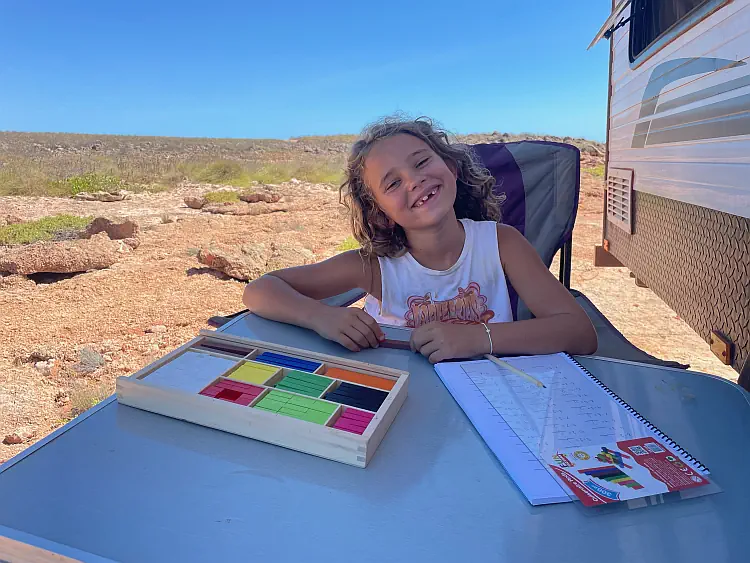
You might find an English program that’s built around flashcards, index cards, letter tiles or blocks, “sentence builder” word cards/blocks and a box full of other fun learning gadgets. You also find yourself a maths curriculum that comes in a large box full to the brim of what look like brightly coloured toys. The day these resources arrive in the mail will no doubt feel like Christmas morning and your kids might even get excited. But what will the scene look like a month later?
If you’re as organised as I am (not), you’ll likely find that both boxes are missing many pieces. You might also discover that you personally are frustrated/bored/overwhelmed by the volume of physical components and find teaching the lessons extremely frustrating for both you and your child.
Or perhaps you have younger siblings in the house and they discover the brightly coloured cards and toys. They have a ball “reorganising” it all one afternoon for you to discover when you’re trying to get a reluctant learner seated for his lesson the next morning.
Of course, it might not go that way. You might be the sort of teacher and your family might be such that these resources are actually the perfect fit. The point is, there really is no “one-size-fits-all” model in homeschooling.
But, perhaps more importantly, the fit is not necessarily determined by your child’s learning style. Yes, that will play some part but the most important consideration by far will be how well the resource fits in with your family’s overall lifestyle and attitude to learning.
With that in mind, the key questions you should be asking when searching for curriculum are:
- How long does a lesson take?
- How many components will there be to take care of?
- Are the components reusable or consumable?
- How much of my time will this require?
- How quickly will my child be able to work independently?
- Is this an online or pencil and paper resource?
- How well will this resource work with multiple ages (and babies or toddlers!) in the house?
You should actually decide what the “right” answers to each of these questions are for your household before you even begin your search.
Another thing to look out for is free trials. If you’re new to homeschooling and have absolutely no idea where to start with that list of questions: free trials can be a lifesaver. That way you can test a few different options to see what actually works for you.
I do believe that there are some universal qualities that will make a curriculum useful for more families in more of their homeschool journey than others. One of the big ones is how much of the parent’s time a resource is going to absorb. Generally, if a resource is going to take a lot of teaching time, it will work best if it can cater to multiple (and preferably all) of your children at the same time. But in a subject like maths, where progression usually varies widely between students, a program that allows your child to work as independently as possible from an early age is going to be a lifeline. Especially when you’ve got younger siblings fighting for your attention most of the day.
Searching for homeschool resources can be an absolute minefield but before you get carried away researching learning philosophies and watching flashy Instagram reviews, stop and consider: what is actually important for you and your family right now? If you answer that question, the right resources will be much easier to find.