
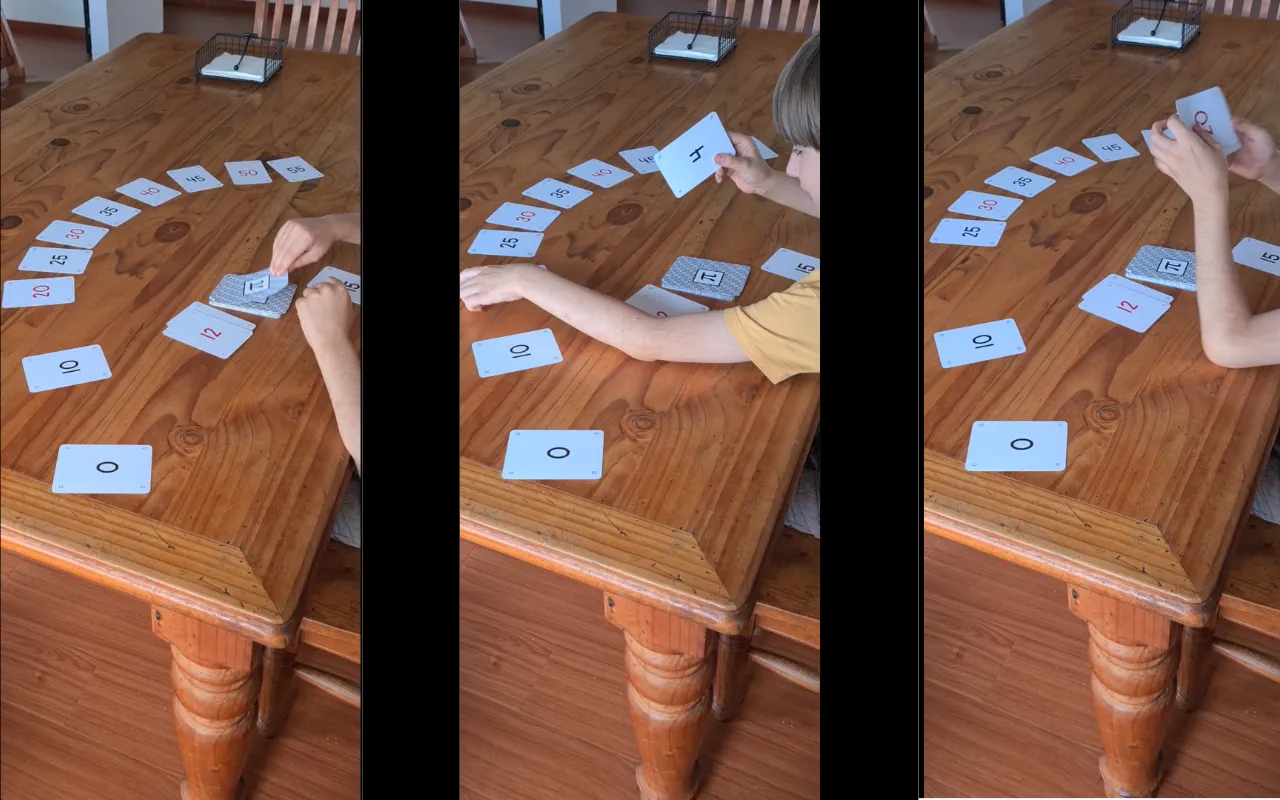
I was looking for a way to practice the five times tables with my boy recently and came up with this simple but effective (and apparently fun) game.
I used the now discontinued Milestone Maths game cards but you can easily do this using a standard deck of playing cards for the multipliers and slips of paper for the answer cards (you could also use a 1-100 flashcard deck for the answer cards.)
Game Setup
First I selected the multiples of five from zero up to sixty (0, 5, 10, 15, … 55, 60) from the deck and laid them out face up in a line on the table. If you have number flashcards, do the same, otherwise write the multiples of five on slips of paper and lay them out face up on the table.
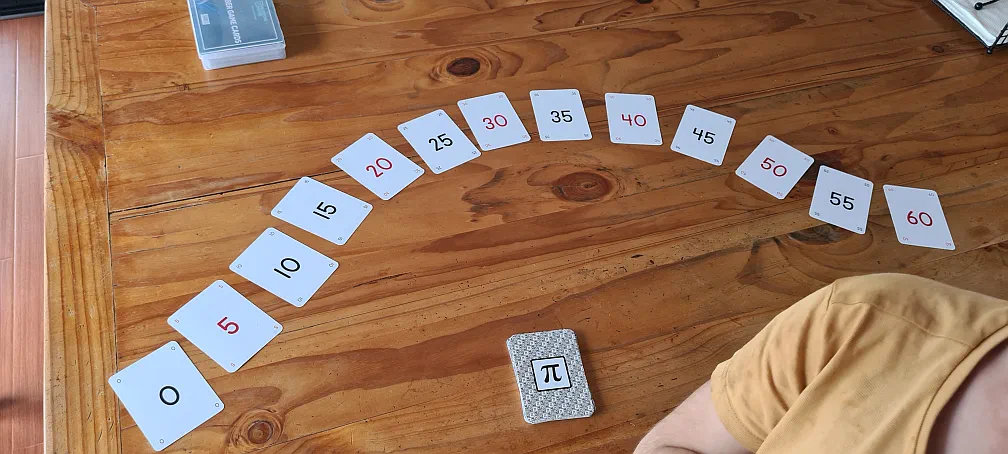
Then I pulled out two copies of each of the numbers 0-12 and shuffled them to make up the multiplier deck. You can use a standard pack of playing cards by removing the joker. Let the aces equal one, kings will equal zero, the jacks can equal eleven and the queens equal 12. If you use the whole deck the game will run longer or you can just use one colour of card so you have two of each number.
Shuffle the deck of multipliers and place it face down beside the line of answers.
Game Play
Let your child go first. If you’re teaching your kids to play this on their own, have the youngest go first or get them to play “rock, paper, scissors” to decide who goes first.
The child turns over the top card on the multiplier deck. Let’s say they turned over a 3. They say, “three times five equals fifteen,” and they take the 15 card (or slip of paper) and the three card and keep it on a pile in front of themselves. If they get the answer wrong, they miss a turn. If another player has already claimed the answer card, they also miss a turn.
Players take turns until there are no more answer cards left. The winner is the one who collected the most cards.
Variations
When you first play this game, the answer cards should be in order from lowest to highest. This will help your kid “work out” the answers by simply counting along the line. Once that gets easy, add an element of challenge by “mixing up” the answer cards.
You could add an even greater level of challenge by stacking the answer cards into a single “deck” rather than laying them out. Then the player needs to search through the deck to find the answer, but they can only do so after they have given the correct answer.
For a young child that is still not confident with the table, you can give them an advantage by allowing them to take the multiplier card if they get the answer right and the answer card has already been taken. The other player should play the standard way otherwise it will be too likely that the result will be a draw.
This game can obviously be adapted to any times table your child needs to learn. You will need to use slips of paper for the multiples when they get over 100, though.
Conclusion
That’s it! It’s a super simple game that takes virtually no time to set up and not very long to play a round. So you can easily set up a tournament and play for “best of three (or five)”. This gets your child hearing and solving the entire table several times in a very short space of time.
In my homeschool, games that require a lot of set up or take a long time to play don’t fly for many reasons. But this game has been a hit and my little one has begged to start every “school day” with it since I came up with it.
Have a go with your kids and then let me know how you went in the comments!