
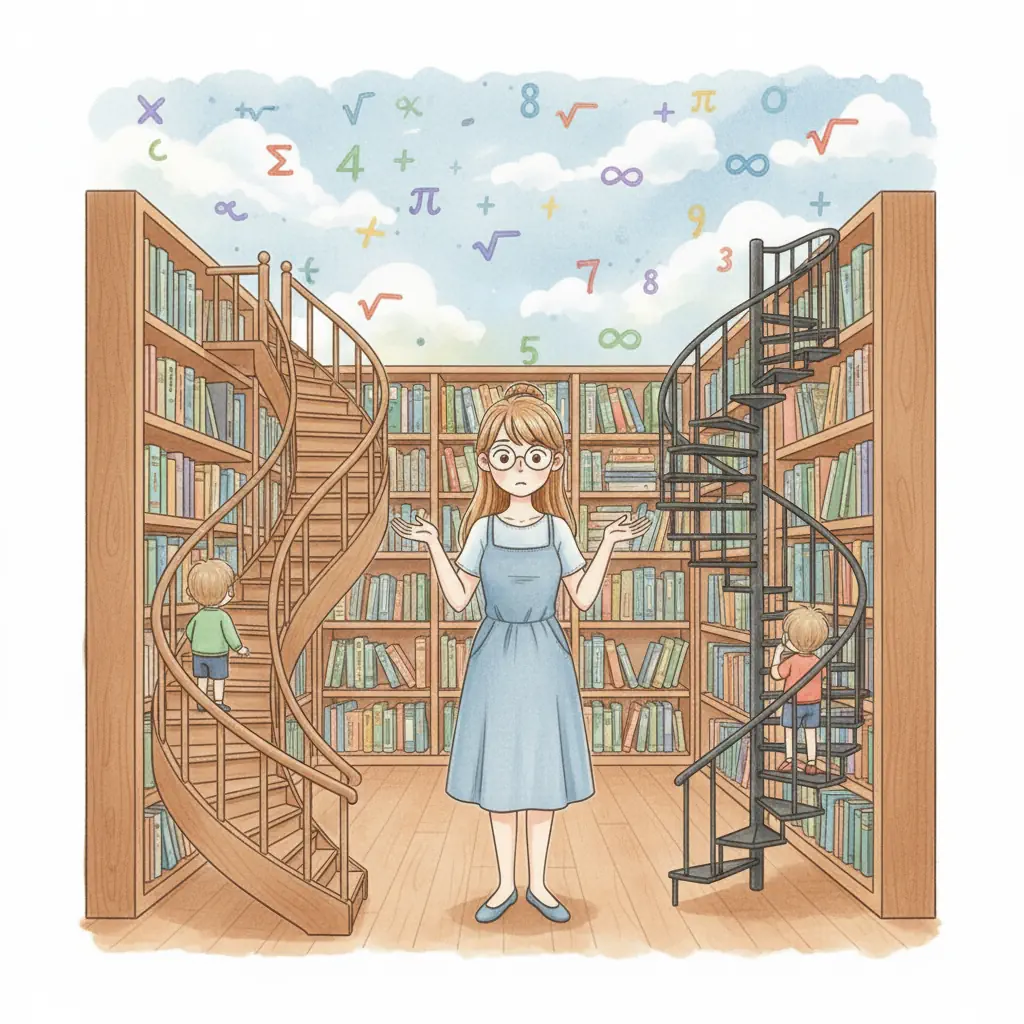
I’m just going to drop the bomb right at the head of this article. There’s actually NO SUCH THING as a pure mastery curriculum. There I said it. But can I defend it? Absolutely.
You see, every single year of any maths curriculum will have an outline that looks something like this:
- Numbers and counting (or place value)
- Addition and Subtraction (then more advanced operations past year 2)
- Measurement and Geometry
- Probability and Statistics
Every year the same round of topics will be covered, but at increasing levels of complexity. Well, that looks suspiciously like a spiral to me. Don’t you think so?
So, the real difference between a “pure mastery” curriculum and what I call a “hyper-spiral” curriculum is how often, and for how long, a child studies topics from each of the above categories.
In a mastery curriculum lessons are usually arranged in chapters and each chapter will be dedicated to only one of the above areas. There will likely be some review within each chapter but there will be very little, if any, review of material from previous chapters in the current one. This makes it easy for the teacher to chop and change topics as they please but it can lead to a child that forgets everything they’ve been taught about a topic the second the end of chapter review (or test) is done.
In a hyper-spiral curriculum, there are typically no chapter divisions or, if there are any, they are usually a fixed number of lessons long and have no cohesive structure. Each lesson may focus on a totally different area to the one before it. Every lesson is also typically much more heavy on review than it is on explaining and practicing the new material. In theory this means that the child won’t forget the material so easily, but the constant changing of topics can be dizzying (not to mention confusing) to many children.
So which approach is better?
The Truth About How We Learn
Decades of psychological research have shown that for long-term learning and retention, the best strategy is spaced repetition. This is the act of reviewing previously learned material at increasing intervals over time.
So, if all curricula spiral in some way, the real question is: what is the ideal length of a spiral?
Finding the Sweet Spot
In practice, all maths curricula are on a spectrum, and the ‘best’ curriculum is one that finds the sweet spot between deep understanding and regular review. A curriculum that focuses solely on mastery can lead to your child forgetting the material unless you, the parent, are diligent about implementing review activities.
On the other hand, a curriculum that spirals too quickly, revisiting topics daily, can be confusing and lead to a shallow understanding of the topics presented. This is often the frustration you hear about from parents.
The ideal learning presentation is a combination of both methods:
- Deep Dives: The curriculum should offer moderate-sized units of study that are long enough to allow a concept to ‘sink in,’ but short enough to maintain your child’s motivation.
- Constant Review: To keep important skills and facts fresh, each lesson should also incorporate some review of previously learned concepts.
- Functional Design: A clean, high-contrast layout that is easy to follow from lesson to lesson is supreme. This helps the key message take centre stage, ensuring maximum learning efficiency.
Milestone Maths: The Best of Both Worlds
This balanced approach is what Milestone Maths adopts. Each of our units (or milestones) runs for approximately one to three weeks and focuses on one particular topic. This gives your child the time to truly master each concept before moving on.
But at the same time, each of our lessons includes a page of review activities that refresh important concepts from previous lessons. We also include an optional drill at the end of each lesson to help cement basic maths facts.
Our curriculum is designed to combine the focus needed for deep understanding with the consistent review needed for long-term retention. It’s a method that avoids the frustration which leads to math phobia and helps your child develop a true love for the subject.
Ready to see how this approach can work for your kids? Head on over to our products page now.