
Reimagining Maths Teaching Part 3
Last week we learned that number sense is developed, not taught. We also saw that while we can’t explicitly teach number sense, we can provide the ideal conditions for a child to develop number sense by helping them to discover the underlying patterns and structure of numbers.
This week we’re going to look at one place where that structure truly shines. The multiplication table:
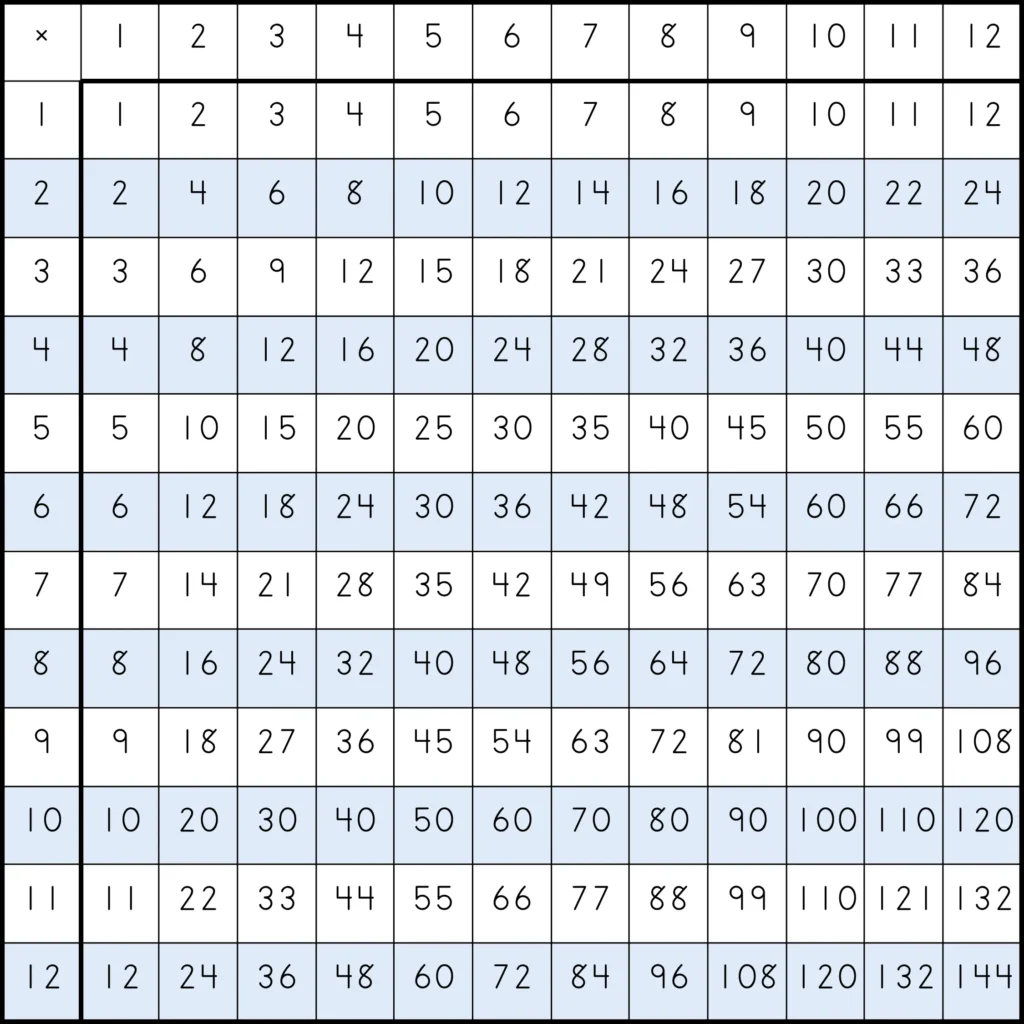
What comes to mind when you look at that table? Is it a treasure trove of patterns: some popping right out at you and others waiting to be discovered? Or is it a sea of confusing facts that you were forced to memorise?
If it’s the latter, I’ve got good news for both you and your kids! There’s actually no need to memorise the entire table. In fact, there’s really only a very small handful of facts that really need to be memorised by rote. We’ll learn why next week.
Now, while your child doesn’t necessarily need to be memorising the table by rote (“two times three is six; three times three is nine;…” style), they will need to become very familiar with the numbers in the table.
Why? I’m glad you asked! You see, absolutely every aspect of maths beyond year 5 leans heavily on the numbers in that table!
Let’s take a little look at some of the key topics covered in maths from year 5 onwards that depend on nearly instant recall of the basic multiplication number facts.
- Division: Division is the inverse of multiplication and it is simply impossible for a child to divide easily if they don’t have a solid grasp of the related multiplication facts.
- Fractions: for a child to be able to simplify or work with fractions they simply must have a good grasp of what numbers are factors of other numbers. For example, it is impossible to simplify the fraction 24⁄27 without knowing that both 24 and 27 are divisible by three.
- Ratios and proportions: “If 3 apples cost $2, how much do 7 apples cost?” This requires multiplicative thinking. A child who only understands addition will get stuck trying to solve this.
- Percentages: “Find the price of a t-shirt that is 15% off the marked price if the tag says $25.” This requires the child to multiply by 15⁄100. If they have to work out each of the multiplication facts along the way, this becomes impossibly tedious.
- Area and Volume: Both these concepts are literally direct real-world applications of multiplication. In fact, area is so closely related to multiplication that in Milestone Maths we introduce area as a model for multiplication before we even teach it as a geometry concept.
And then we come to algebra. Now, some homeschoolers will want to politely excuse themselves at this point with, “My kid wants to go into the trades: they’ll never need algebra.”
But before you take that line, please take a moment to ponder this view. To summarise, learning higher level maths is not just about vocational training: it’s about learning how to think systematically, precisely and logically.
Let’s consider why the multiplication truly is the foundation of algebraic thought:
- When a student needs to factorise x² + 7x + 12, they need to instantly recognise that 3 × 4 = 12 and 3 + 4 = 7.
- When they’re simplifying algebraic fractions, they need to spot common factors instantly.
- When they’re solving quadratic equations, expanding brackets, or working with polynomials—every single step requires multiplicative fluency.
A student who has to calculate basic multiplication facts while simultaneously trying to understand a new algebraic concept has no cognitive bandwidth left for the actual learning. The result is almost always the same: a feeling of failure or inadequacy.
I’ve seen it time and again in my tutoring practice. A mother brings in her year 8 child who’s getting poor grades in maths. “What’s the trouble?” I ask. The reply is always the same, “I don’t understand algebra.” Often followed by, “I think the teacher doesn’t like me.”
I nod my head and then hand the student a piece of paper saying, “Now this might look basic, but trust me. Just have a go.”
It’s a basic 100 fact multiplication drill. Almost without exception, the student will begin struggling from the second or third problem on the paper.
Their primary school teachers were so busy teaching specific mental maths “strategies” they thought were required by the curriculum that they neglected something more fundamental. They failed to ensure each student achieved fluency in basic multiplication.
“Fluency in multiplication” just means that you can instantly recall the answers to all the problems on the multiplication table. This fluency is actually a content descriptor in Version 9 of the Australian Curriculum. It’s not optional—it’s required. Yet very few students seem to acquire it. And, as far as I’ve been able to gather, very few classrooms explicitly teach it.
So does this mean “drill and kill” really is the answer? Well, for some kids, rote memorisation of the ilk, “two times two is four, two times three is six,” is actually enjoyable and effective.
But for many, perhaps most, it’s not. What is much more effective, is allowing the child to use the table to solve copious problems, while at the same time helping the child to discover patterns and structure within that table.
So what structure is actually hiding within the multiplication table? We’ll see that next time.
And we’ll also see how that structure reduces the amount of learning our kids need to do significantly.
Next week: Why Learning the Multiplication Table is Easier Than it Looks.