
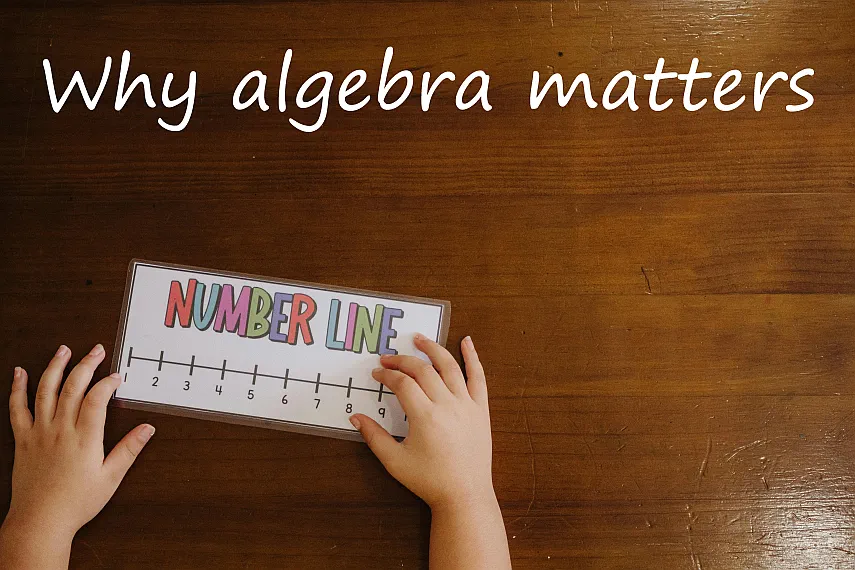
Why abstract mathematics teaches children far more than equations
As homeschool parents, we want to prepare our children for life. It’s natural to ask questions like, “What skills will my child actually use?” and “How much maths do they really need?”
It’s tempting to believe that most of high school maths is just taught to fill in the time that kids are required to be at school. After all, most of the arithmetic that most adults use “every day” is taught fairly early in primary school.
But the reality is this:
The point of algebra is not algebra.
Before we look at what the true value of learning algebra is, let’s look at why it is so much maligned or at least feared. I suspect most aversion to algebra in parents is due to their own poor experiences with the subject. It is very likely they had the same unfortunate experience I see with many of my students.
Ironically, the root cause of this poor experience with higher level maths isn’t the algebra. It’s actually a poor foundation in the basic “every day” arithmetic that is considered essential by virtually all homeschoolers. We’ll go into exactly how that works later.
But assuming the foundations are sound, algebra is not a “pretty but useless” addition to a child’s education. The point of algebra is not to find “busy work” to fill in an extra 5-7 years of education.
Rather, algebra is the very essence of abstract thought: the type of thought that gives rise to the uniquely human traits of creativity, reasoning, independent thought, analysis and planning.
And it’s no accident that the teaching of algebra formally begins around the age of 12, when a child’s brain usually begins to develop the ability to engage in abstract thought.
You see, algebra is about learning to generalise and form solutions to types of problems rather than one specific example. It teaches flexibility of thought and adaptability.
These are skills that make a person prepared to deal with changes in technology or employment and they are highly compatible with the aim of virtually every educator and home school parent: the ability to engage in lifelong learning.
Let’s look at a concrete example. A child can learn very early that 3 + 2 = 5. If they are well taught, they will also recognise that 2 + 3 = 5 is describing essentially the same relationship. In algebra the child will learn that the relationship holds no matter what the numbers are:
a + b = b + a
That relationship works whether a and b are counting numbers, as in our first example, or fractions or decimals or just about any other type of number.
An even more powerful example is the reversibility of operations. In Milestone Maths, very young children (as early as Level B) begin to appreciate that addition and subtraction are opposites. They understand that if they know 23 + 15 = 38, they can easily work out 38 – 15.
By level C, the particularly thoughtful ones realise that the relationship between multiplication and division is very similar to that between addition and subtraction. Most children are not capable of seeing these relationships on their own, but when the underlying arithmetic is presented in the right way, they can be led to see them.
These apparently simple observations are extremely powerful and they form the basis of algebraic thinking.
Yet, unfortunately, many primary school curriculums and teachers are not fully aware of the many and deep relationships between the basic arithmetic operations and the algebra that follows on as a natural progression.
Because the teachers themselves are unaware of this natural progression, they are unable to show it to their students. This is why algebra seems new and mysterious to most early high school students. It seems to “come out of nowhere.” It feels alien and unapproachable.
And the sad result is that, not only is the student unable to understand algebra, they lose out on developing a deeper appreciation of, and ability with, the basic mathematics that they will be using every day of their life.
Sadder still. They will miss the real point of algebra.
You see, mathematics is not valuable simply because children may one day need to solve equations by hand. In fact, many adults will rarely use formal algebra directly in their daily lives.
But that misses the point entirely.
The value of algebra lies in the habits of mind it develops: the ability to recognise patterns, to think logically, to generalise ideas, to analyse relationships and to work systematically through unfamiliar problems.
These abilities reach far beyond mathematics itself.
They shape the way a person approaches technology, learning, problem solving and even life.
As homeschoolers, we rightly want our children to be prepared for the “real world.” But real life is not static. Technology changes. Careers change. Society changes. The people who thrive are rarely those who simply memorised the most immediately useful information. They are the people who learned how to think, how to adapt and how to continue learning throughout their lives.
That is why algebra matters.
The point of algebra isn’t algebra.
It’s learning to think.