
Reimagining Maths Teaching Part 4
In our last post of this series, we looked at why learning the multiplication table is key to understanding virtually all of the maths that comes after it. In this post, we’re going to show why the task is a whole lot easier than it looks at first glance.
Let’s start with a blank times table:
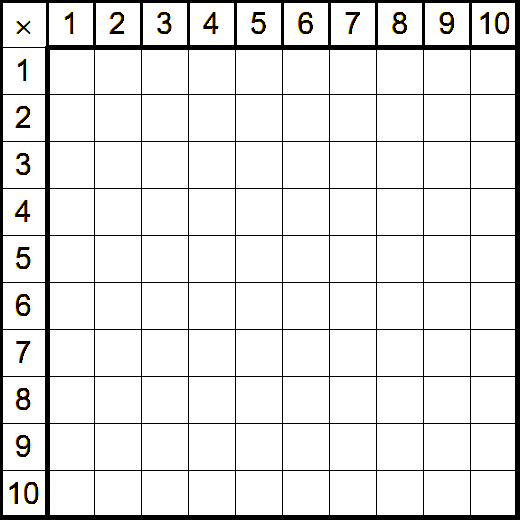
The first thing to notice (and tell your student) is that one times anything is the anything. So the first row and column are just copies of their respective headings. Too easy!
Then there are three other counting patterns that most kids find pretty easy to master:
- counting by 2’s;
- counting by 5’s; and
- counting by 10’s
So, let’s see what the table looks like with all those easy rows and columns filled in:
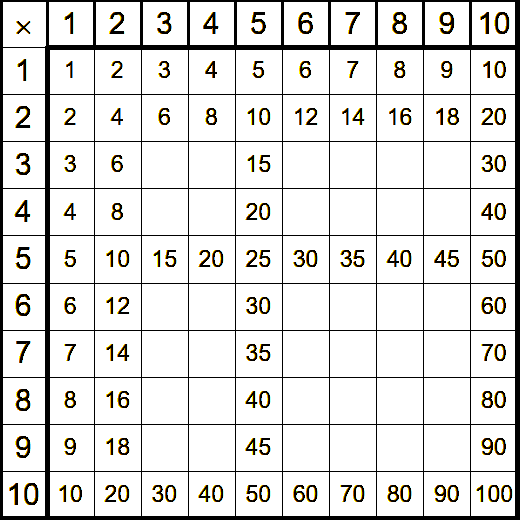
With just those few easy rows and columns filled in, we’ve already reduced the problem from needing to learn 100 new facts, to only 36. We’ve already solved more than half of the problem!
Now, there’s a pattern that I love showing my students. It’s hiding in the 9 times table. Take a look at the table below and see if you can find it:
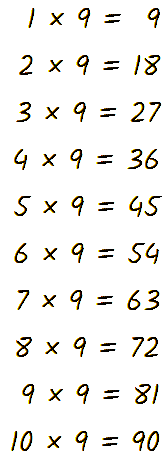
Observant students will notice that the tens digit is counting up while the ones digit is counting down. There’s an even more intriguing (and useful) pattern. Add the digits of each answer together. (Eg 36 gives 3 + 6 = 9) You’ll find that every single answer has a “digit sum” of 9!
Once this pattern has been pointed out to the students, they usually have little trouble filling in the nine times column and row.
The next easy column and row is the four times table. To find four times a number double, then double again. (In Milestone Maths we call this the “turkey table” because “double, double” sounds a bit like “gobble, gobble.”)
So, with these two tables filled, our table now looks like:
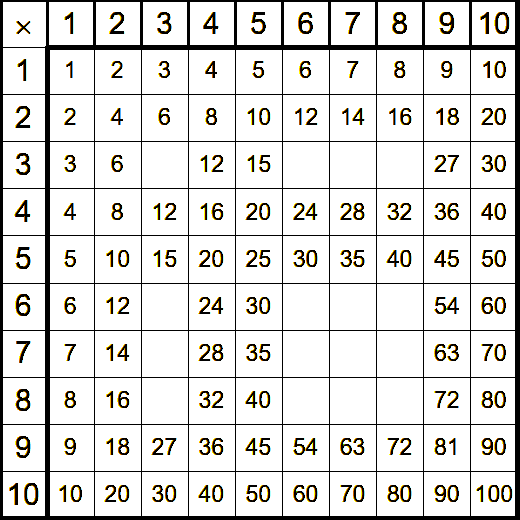
There’s now only 16 cells left to fill and we haven’t even broken a sweat yet!
The diagonal that goes from 1 × 1 to 10 × 10 represents the square numbers. Square numbers, like doubles in addition, are often easier for kids to remember than some of the other facts just because they’re a bit different.
In case you’re wondering, they’re called square numbers because when we draw an array model of the multiplication, we end up with something that looks like a square. For example, let’s look at 3 × 3:

The next thing to teach your child is how to count by 3’s. When they see that this is just adding three repeatedly, it’s not that hard to do. Another way to look at ×3 is to think of it as “double plus one.” In other words, three times a number is the same as two times the number plus the number again.
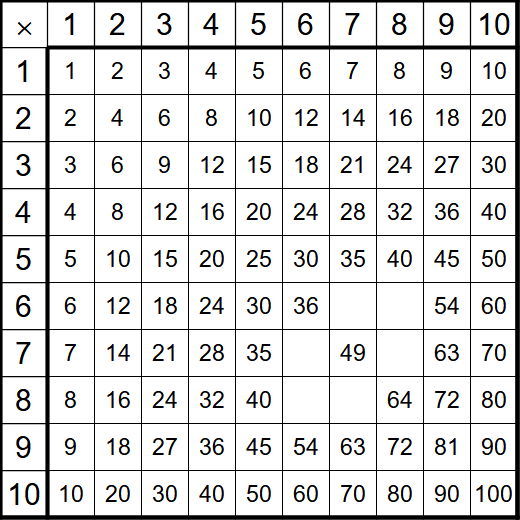
Now there’s only 6 cells left. But, wait! There’s still more to discover. Take a look at the table with a little colour added:
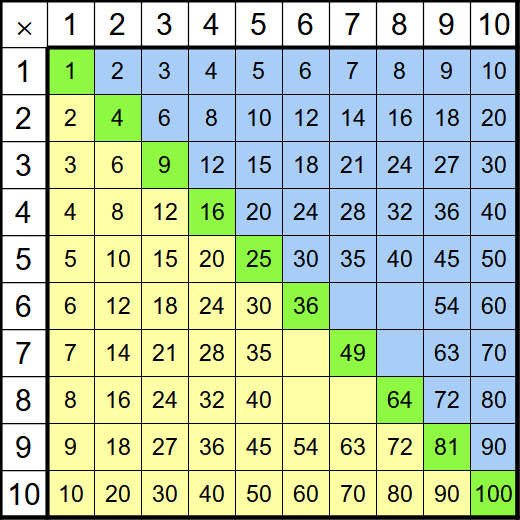
The blue and the yellow sections are just reflections of each other around the green line. This is a result of the commutativity principle. For example, 7 × 6 is the same as 6 × 7, so your child only has to remember one of these.
To fill in the last few cells, your child can simply memorise them (there’s only three unique facts!) or they can use the idea that multiplication is repeated addition and “add on” from the cells that are known.
So getting the multiplication table filled out is much easier than it looks at first. Now, I stressed last week that these facts need to be learned to the point of instant recall. Obviously, filling out the table using the “tricks” we’ve looked at here is not going to cut it long term, but it’s an excellent “stepping stone” along the way.
Ideally, your child should be filling out a blank table like this regularly and then using it to solve copious problems until they become so familiar with it that they can solve the problems without looking at the table. At that point, they should know their tables well enough to concentrate on the concepts in higher level maths, rather than getting stuck on the basic arithmetic that tags along for a ride.
These ideas are implemented in our book Taming the Table. We’ve included a free sample below, which gives you a blank times table you can use with your child to explore these patterns in action.
If you’d like a fully structured walkthrough of this method, you can get the full book here.
For families who want to go further and build a complete approach to developing number sense across all areas of mathematics, Milestone Maths provides a full curriculum designed around the same principle: understanding first, fluency follows.