
In our last post, we looked at why algebra deserves a place in the homeschool curriculum. This time, we’re going to explore how the way maths is taught in primary school can set children up to either succeed or struggle with algebra right from the Foundation year.
In my work as a tutor, I repeatedly see three misconceptions that cause students to really struggle with high school maths. Whether these are caused by the curriculum or the teaching methods or the student’s inattention, the result is always the same: algebra becomes mysterious, disconnected and almost impossible to understand.
The first misconception that makes algebra difficult for many students is rote memorisation of procedures or algorithms without understanding the relationships those calculations represent.
I know this has happened when I get a blank stare in answer to a question like, “Why did you add these numbers?” I like to ask questions like this even when the student has performed the correct operation. The confident student will explain their reasoning. The not-so-confident student will either stare blankly or randomly begin performing a different operation.
To avoid this error, every operation needs to be carefully introduced and properly explained. The task is not really difficult, but it does need to be approached in the right way.
In essence, all mathematical operations involve combining groups into a total or dividing a total into groups. This basic idea can be taught to even very young children with only a handful of simple materials.
In Milestone Maths we use Sumstix to show number relationships while avoiding the unit counting that can prevent kids becoming fluent at the basic operations. But in the beginning we also use basic counters (using any everyday object available) to establish that numbers actually do represent quantities and to show the grouping explicitly.
We also introduce helpful abstract representations (like number bonds and bar models) long before the concrete materials are removed but after the concepts have been thoroughly explored with the concrete materials.
But most importantly, every single operation or concept that is taught, must be rooted in the child’s real world experience. As an example, let’s look at how subtraction is introduced in Level B of Milestone Maths. Once the idea of addition has been thoroughly practiced, the idea of solving missing number problems is introduced. Because of the constant repetition, and the scaffolding provided by the Sumstix, this is a fairly simple step for the child to take.
Then, and only then, is subtraction introduced, not as an abstract idea, but in the context of a story problem:
Seven birds were sitting on a fence. A squabble broke out so three birds took off and flew away. How many birds were left sitting on the fence?
And, rather than giving the abstract equation at the start, we draw a picture of seven birds and cross out three of them to represent the ones that flew away:

Grounding everything the child learns in the known and “real world” gives them both confidence and deep understanding. This smooths the transition to algebra and also ensures that they understand how operations behave even when numbers are replaced by letters and symbols.
Moving from single-digit operations to algorithms for dealing with larger numbers is another area that can cause problems for the transition to algebra. In this case, it’s not only the way that the algorithms are taught that matters but the actual algorithms presented need to be carefully selected.
One debate that has caused me some amusement is that over which subtraction algorithm is “the best”. There are two algorithms that have historically been used but many people believe that one is the “old” way and the other is the “new” way. Whether the old or new is better depends on whether you’re progressive or conservative, I guess. The truth is, neither is superior to the other and both teach different aspects of how numbers work so both are valid and both are taught in Milestone Maths. You can read more about this in The Great Subtraction Debate.
When we get to multiplication, however, there are myriad algorithms taught and some of them are definitely of more use than others.
One algorithm I’ve seen some of my tutoring students using is called lattice multiplication. It looks really cool and, once you get the hang of it, can be easier to implement than the “standard long multiplication” algorithm. But it completely obscures the actual structure of the numbers you’re working with. This can become a big problem when the child gets to algebraic multiplication because the distributive property is a totally new (and foreign) idea to them.
One common “sticking point” for kids learning the standard algorithm is knowing what to do with carries: they need to keep swapping between multiplication and addition. This can be a big cognitive load, especially if their times tables aren’t secure.
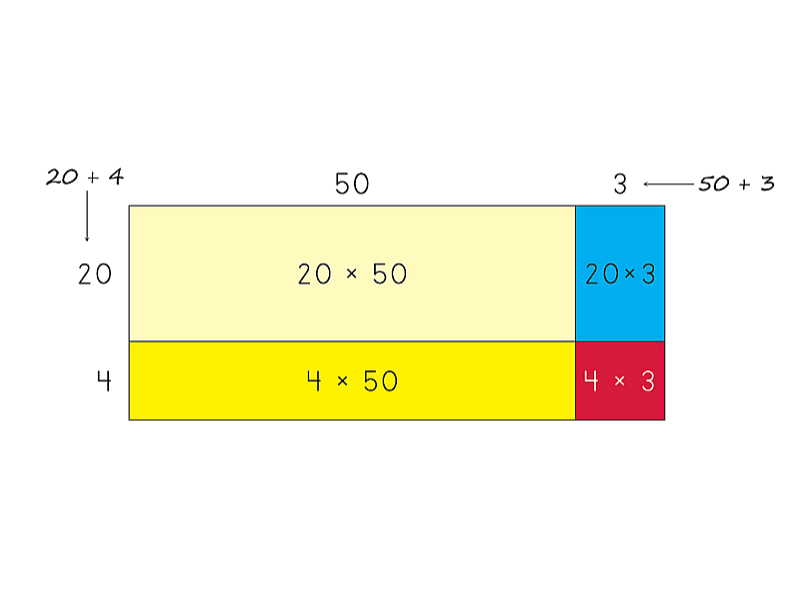
My approach to teaching multiplication reveals the distributive property of multiplication but also avoids the “swapping and changing” of the standard algorithm. First, we show the kids how to multiply any number by ten. Then we show them how to multiply 2-digit multiples of ten by 2. This is a simple case of multiplying the first digit by 2 and then “tacking on a zero.” Then we show them that we can multiply and two digit number by 2 very easily. First they find the “expanded form” of the number and then multiply each part of the expanded form by 2 and finally add the two multiples together.
In essence, we show that 58 × 2 is the same as 50 × 2 + 8 × 2. Mathematically we write this as 58 × 2 = 2 × (50 + 8).
This is the exact same thinking process the child will need in algebra to expand expressions like 2( x + 1). But even more valuable, it also lends itself to solving many multiplication problems mentally with relative ease. So, we’re using algebraic thinking to solve a very real “every day” problem!
In Level E we take the conceptual look at multiplication a step further and show that multiplication is really just the process of finding the area of a rectangle. We then relate this to the very real world application of finding the area of actual constructions – rooms, garden beds, sports fields, etc.
In my tutoring practice, I’ve observed that the way multiplication is taught in the primary years is really the “make or break” condition for algebra. The only other topic that has nearly as great an influence on how easy or difficult a child finds algebra is fractions. But understanding fractions hinges on a sound understanding of multiplication and division, so we’ve come full circle!
Now, assuming a child has been taught the right algorithms in the right ways and has a very good conceptual understanding of maths, there’s still one factor that can make the transition to algebra much harder than it needs to be, and can often leave the child thinking they are simply “no good” at maths.
That factor is fluency. Fluency is a term that appears several times in the Australian Curriculum maths syllabus and you’ll hear it often in reference to both reading and mathematics. But what does it really mean? From my observations of online discussions, it would seem that even some teachers aren’t quite sure.
Well, there’s nothing really special about the term when it’s used in the context of maths. It really is very similar in meaning to the way it is used in the sentence, “He’s very fluent at French.” When you’re fluent in a language, you can use is almost as easily as your “native tongue,” or first language.
To be fluent with the “maths facts” means you can recall them almost instantly. You recoginse all the numbers in the multiplication table when you see them. And, when you’ve really practiced to the point of “overlearning,” you begin to see patterns that allow you to extend beyond the basic 10×10 table.
But why is this so important? Well, the arithmetic in algebra is actually very simple but there’s one, absolutely non-negotiable requirement for most of it to make sense: you must be able to spot a number that belongs on the multiplication table and you must be able to factorise it (that is, give all the numbers that divide into it evenly). Without that basic knowledge, it is practically impossible to follow most algebraic processes beyond the first simple examples.
The reason for this is that most algebra involves either simplifying fractions or factorising numbers. Both of these hinge on an intimate knowledge of the multiplication table. So, while I do not advocate drill for its own sake, I do absolutely require every one of my students to learn their multiplication table to the point of instant recall. Interestingly, I find that most people seem to have less difficulty learning their multiplication table than they do learning the basic addition table. I suspect that is because there are so many interesting patterns in the multiplication table. Read more about that here.
We’ve looked at three pitfalls in primary maths education that can make the transition to algebra far harder than it needs to be. But the good news is that it doesn’t have to be this way.
When arithmetic is taught so that the underlying structure of numbers and operations is revealed rather than hidden, algebra becomes a natural extension of patterns and relationships the child already understands.
And that is the benefit of a curriculum written by someone who understands both the deep connections between early arithmetic and algebra, and the way young children actually learn mathematics.