
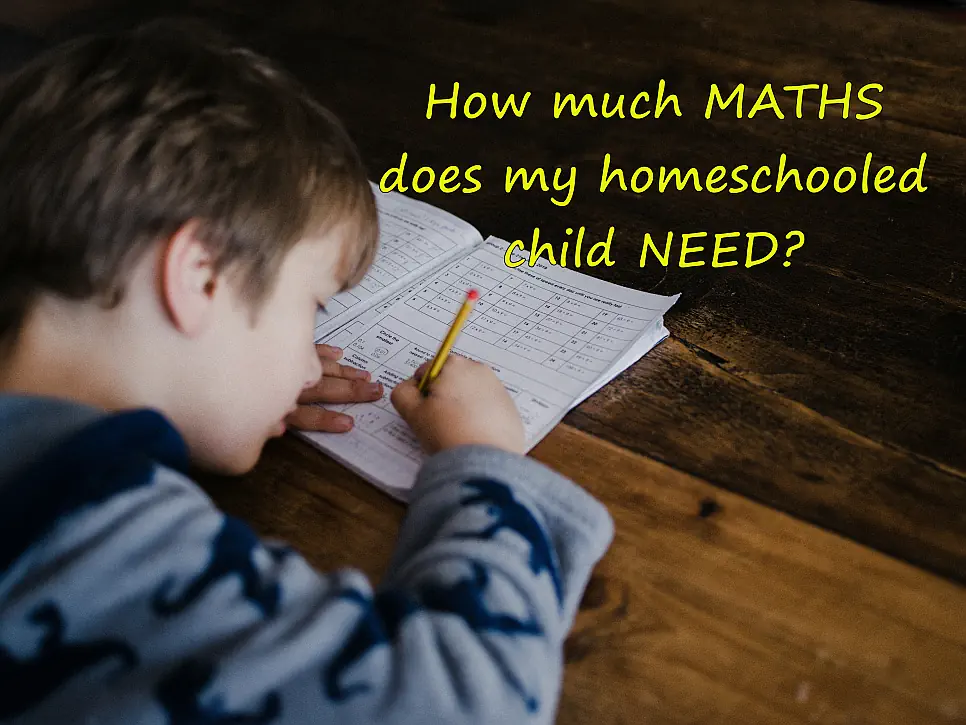
If you’ve ever homeschooled a tween or teen, chances are you’ve heard the question: “Where am I ever going to use this?”
From time to time I see something on the socials that makes me sigh. There’ll be a parent asking a question along the lines of, “my boy doesn’t like bookwork and is interested in the trades so do we really need to do high school maths?” There will often be a lively discussion with various opinions on the matter. My least favourite answer that I’ve seen to such a query was, “Real life only requires Year 4 maths so there’s no need to bother with any more.”
Now, I get where these parents are coming from. I truly do. I’ve been there. Struggling with a reluctant tween or teen who demands, “Where am I going to use this?” practically every second of the homeschool day. And while I did and do believe in student lead learning for the most part, there were always a couple of non-negotiables in our homeschool. Maths was one of them.
Why? Because even though you technically can get through life with little more than the ability to add, subtract, multiply and divide simple whole numbers and a basic handle on decimals, learning maths is much more about developing a way of thinking than simply navigating real life.
Learning maths is much more about developing a way of thinking than simply navigating real life.
As homeschoolers, one of our aims should be to give our children a broad range of skills and experiences to prepare them to face whatever life may throw at them.
In our own homeschool we gave our children a wide range of experiences: piano lessons, art classes and swimming lessons. We didn’t expect any of our children to be a concert pianist, a master artist or an Olympic swimmer but we did know that the skills they were being exposed to would be valuable no matter what their final career path. Piano develops left-right brain thinking like nothing else can, art hones design, observation and creative skills while swimming fosters discipline and resilience.
Mathematics does something just as important: it trains the mind to think clearly, logically and critically.
When a child grapples with a complex mathematical problem they learn to analyse a situation, break down a problem into simpler blocks, test a solution, recognise when something doesn’t work and try again. They learn that careful reasoning can lead somewhere and that persistence pays off.
They are training their mind to give attention to detail, think logically, solve problems and persevere through setbacks. These are skills that will be valuable to them no matter what path through life they take.
So when someone says, “Real life only requires Year 4 maths,” they’re seriously missing the point.
Learning maths is not just about counting change or keeping tabs on your budget: it’s about learning to think, evaluating data and analysing claims.
And just because your child currently feels they will not need maths in their future lives doesn’t mean they won’t find themselves wishing they had done higher level maths one day.
My own cousin left school in Year 10 (back when that was the norm) to pursue a trade in carpentry. He was hoping that his maths classes (which he hated) were finally over. To his dismay, he was thrust into a class on trigonometry in his first Year at TAFE! Having done his best to ignore his maths teachers for his four years in high school, he found himself severely unprepared for the class. Luckily, his mother, a “lowly” nurse, had studied, and done well at, “technical maths” in Europe so she was able to tutor him through the situation.
Why did he study trigonometry? Would he be likely to use much that maths on the job? Probably not. But TAFE understands that learning the theory behind the practice gives the carpentry student a depth of understanding that allows them to be creative when they choose (or need) to while still keeping the structure safe.
But if high school maths is valuable, what curriculum does a homeschooler use? There are precious few high school maths resources written specifically for home schoolers. Most resources require the educator (parent) to be experts in the maths in order to teach it appropriately. Unfortunately, for most homeschoolers, this simply isn’t the case.
Milestone Maths is working on solving this problem. While we currently only have primary school materials available, we plan to develop all the way to Year 12. With Kathy’s engineering background we also uniquely understand both the theoretical and practical implications of the maths from the earliest levels. So, we’re actually laying the groundwork for high school maths right from Year 1.
One place that this is evident is in our “old meets new” approach to mathematics education. We recognise that the modern focus on developing number sense through mental methods has its merits and we adopt and adapt those approaches that are valuable both in practical every day contexts and in building foundations for higher level maths. But we also understand that the “old fashioned” focus on developing fact fluency and pencil and paper algorithms also forms part of the solid foundation required to truly understand and master higher level maths so we blend this in with as much fun and practical application as we can muster.
So how much maths does a homeschooled child really need?
Not just enough to get through daily life, but enough to stretch their thinking.
Not just enough to get through daily life, but enough to stretch their thinking, challenge their reasoning and open doors they may not even know exist yet.
As homeschoolers we rarely expose our children to music, art, sport or science because we expect them to become professionals in those fields. We do it because each discipline develops something valuable in them.
Mathematics is no different.
It shapes the way they think. And that is reason enough to give it the place it deserves in a homeschool education.
Leave a Reply
You must be logged in to post a comment.