
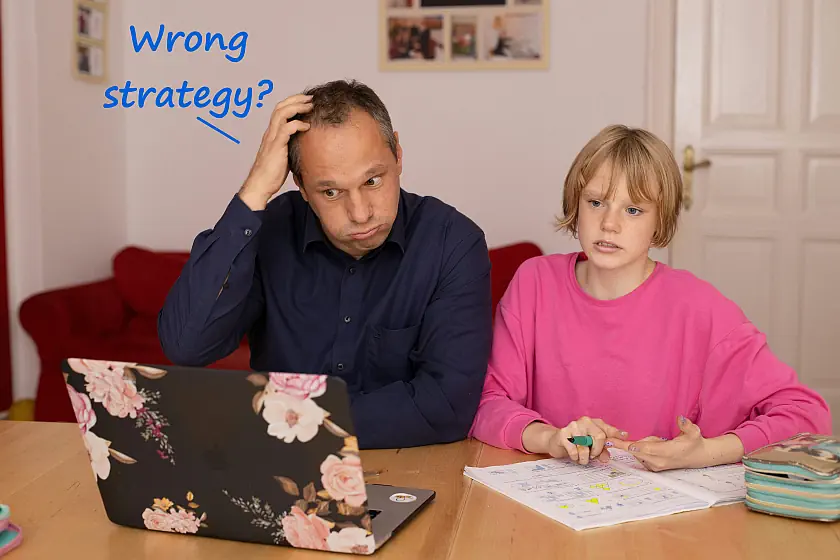
Reimagining Maths Teaching Part 2
In the last post, we looked at why teaching maths as a collection of rules and procedures often fails.
The modern response has been to focus on something called “number sense.” But what exactly is it—and does teaching it actually solve the problem?
At its heart, number sense is the ability to work with numbers flexibly and comfortably.
As the usual story goes, a person with good number sense can easily multiply any number by 9 by recognising that 9 is just one less than ten. For example, 35 × 9 is the same as 35 × 10 – 35 which equals 350 minus 35 or 315. A person with poor number sense, the story goes, needs to reach for a piece of paper (or a calculator) to do the same calculation.
It’s also a very common assumption that to be good at maths, one needs to have good number sense as per the above definition. But is this always the case? From real-world observations I would have to answer, “that depends.”
When I was an undergraduate student at university most of my fellow students were young men. Fairly early in the piece I discovered that many of them had several clever calculation tricks that I never even come across. Did that make them better at maths? Well, I was the only student in the class that went on to study the most difficult mathematics elective and I even tutored one of them through some of the algebra in our engineering subjects.
What I did have was a sound understanding of place value and an appreciation of the patterns and structure underlying mathematics. I also had no need for mental tricks to recall basic number facts because they were familiar to me through the bucket loads of practice my high school teacher gave me and my classmates in basic algebra.
Many of those mental tricks were also of very little use for me because most of them required a level of working memory that I simply do not possess. My modus operandi for solving any mathematical problem was always (and still is) to have a scrap of paper on the side of my main work to do any quick calculations I may need along the way.
Does that make me at all mathematically disabled in some way? I don’t think so. Am I able to calculate the change I should expect at the supermarket checkout? Most of the time. Do I realise that I will get less heavy change if I hand the cashier fifty dollars and fifty cents to pay a bill of thirty dollars and fifty cents. Certainly. Did I receive any training in “number sense” and “mental math strategies” to achieve this? Definitely not.
So does that make number sense something that you innately have or don’t have? I don’t think so. What I did receive in my schooling was copious practice solving real problems. Not contrived ones which only exist to illustrate some pet ‘strategy’ that the teacher is highlighting this week. I was also blessed to have a teacher that didn’t insist that “his way” was the only legitimate way to solve a problem. Indeed, he often used exams to see if we could apply what we had learned to derive solutions to a completely new problem.
The other thing that I’ve come to appreciate in my tutoring practice is that some children will just never ‘get’ strategies. This is especially true of some special needs kids and those who are more likely to be “bad” or “fail” at maths. These children almost universally need simple and consistent rules or procedures. The key here is simple and consistent. Many traditional algorithms fit into this category and, when taught properly, they form a foundation for all children to succeed or even excel at mathematics. Most strategy based teaching is neither simple nor consistent.
One concrete example of how a simple, repeatable traditional algorithm can be a tool to develop number sense is the following. A person with a moderate level of number sense can easily add 100 to any three (or more) digit number. The underlying skills required to perform this operation effortlessly are a good understanding of place value and the basic ability to count. But, while some young children may apparently have both of these skills, they might still be confused when presented with the idea at first. However, a child who has solved many addition problems vertically using the traditional algorithm will almost inevitably notice the pattern and be able to apply it once their maturity allows for it. The special needs child may never develop that level of maturity but, if they’ve been taught the traditional algorithm carefully, they will still be able to confidently solve the problem!
So, did my university peers have number sense while I lacked it? Not at all. Some of them did have very good number sense, and were very capable engineers. Others, maybe not so much. And while I didn’t have a bag of mental tricks, I appreciated the underlying structure of maths which opened the higher levels of mathematics in a way that nothing else can. Did any of us get taught number sense explicitly. Well, no. The term just wasn’t in the 1980’s educational vocabulary.
The upshot of all this is that number sense is not something that can be taught directly. It is something that develops. The key experiences that nurture number sense are those that:
- reveal the patterns behind numbers and operations,
- build (near) instant recall of basic number facts (addition and multiplication tables),
- provide simple, repeatable and dependable methods for solving common problems,
- provide copious practice at practical problem solving using the basic techniques,
- allow children to use their own preferred methods for solving a problem.
In other words, number sense grows out of understanding, practice, and experience — not from memorising a collection of strategies.
And that raises an important question:
If structure is so important, how do we actually show it to children?
That’s where the multiplication table becomes far more powerful than most people realise.
We’ll see why in the next post.
Next week: Why Learning the Multiplication Table Is More Valuable Than Learning Strategies

Leave a Reply
You must be logged in to post a comment.